

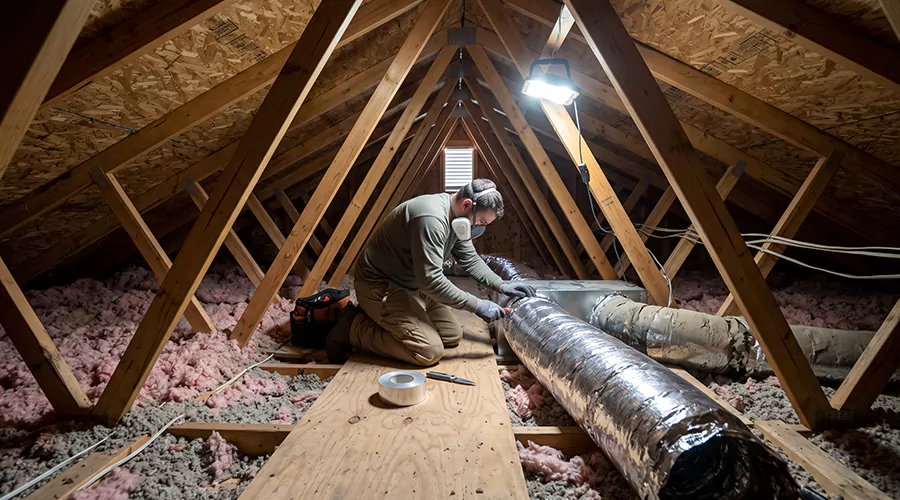
Flexible duct replacement commonly costs $10 to $18 per linear foot in published U.S. installation estimates for 2026, although complete duct replacement projects can cost more when removal, difficult access, and additional fittings are involved. Replacing an individual duct run may cost approximately $270 to $500, while larger residential duct replacement projects commonly range from $1,400 to $5,600.
Flexible ductwork, often called flex duct, carries heated and cooled air from an HVAC system to individual rooms. It is commonly installed in attics, crawlspaces, and other locations where rigid metal ductwork would be difficult to route. The material typically contains a flexible inner liner supported by a wire helix, surrounded by insulation and an exterior protective jacket.
Although flexible ducts are relatively inexpensive to purchase, installing them correctly requires careful attention to sizing, routing, and connections. A duct that is crushed or allowed to sag excessively can restrict airflow even when it is brand new. Improperly sealed connections can also allow conditioned air to escape into unfinished spaces.
The final replacement cost therefore includes more than the flexible tubing itself. Labor, approved fittings, support straps, insulation, and testing all contribute to a complete installation. Understanding these expenses helps homeowners compare quotes and determine whether localized repair or replacement is the better option.
What Is the Average Flex Duct Replacement Cost in 2026?
Published 2026 U.S. estimates vary according to the work included. Angi reports approximately $10 to $18 per linear foot for flexible duct replacement or installation within its broader duct replacement estimates. Another Angi guide lists $6 to $14 per linear foot for professional flexible duct installation, while HomeGuide estimates $25 to $55 per linear foot for more general ductwork replacement that includes removing existing ducts and installing new ones.
These are different pricing categories rather than interchangeable rates. A quote for installing flexible duct may not include removal of old materials or complicated connections. A more extensive replacement price can reflect additional labor and project requirements.
| Flex Duct Project | Indicative 2026 U.S. Cost |
|---|---|
| Insulated flexible duct material | $2–$4 per linear foot |
| Professional flexible duct installation | $6–$14 per linear foot in some estimates |
| Flexible duct replacement pricing example | $10–$18 per linear foot |
| Broader ductwork replacement | $25–$55 per linear foot |
| Individual duct run replacement | $270–$500 for many straightforward projects |
| Larger residential ductwork replacement | $1,400–$5,600 |
The lower material prices do not include the full installation process. Labor, fittings, sealing products, support materials, and removal of damaged ductwork may account for a substantial part of the completed project's cost.
A contractor should provide one total price for the agreed replacement work. Homeowners should avoid assuming that the lowest published per-foot figure represents a finished installation in a difficult attic or crawlspace.
How Much Does Flex Duct Replacement Cost per Linear Foot?
The cost per linear foot depends on duct diameter and whether the installation requires insulation, fittings, or removal of existing material. A short flexible branch connected to existing sound collars may cost less than a long run requiring new junction boxes or changes to the HVAC layout.
The following table uses the $10 to $18 per-foot flexible duct replacement estimate to illustrate how costs can increase with length.
| Flexible Duct Length | Example Cost at $10–$18 per Foot |
|---|---|
| 10 feet | $100–$180 |
| 20 feet | $200–$360 |
| 30 feet | $300–$540 |
| 40 feet | $400–$720 |
| 50 feet | $500–$900 |
| 75 feet | $750–$1,350 |
| 100 feet | $1,000–$1,800 |
These amounts are calculations using one published price model, not guaranteed contractor invoices. Minimum service charges can make a ten-foot replacement cost more than the calculated amount. Difficult access and additional construction work can also raise the total.
The contractor should measure the required installed length rather than simply reproduce a damaged duct's existing route. An old branch containing unnecessary loops may be longer than needed. Correct routing can reduce material use and improve airflow when the duct design permits it.
How Much Does It Cost to Replace One Flexible Duct Run?
Replacing a single residential duct run commonly costs approximately $270 to $500 in published general duct replacement estimates. The project normally involves removing one damaged branch and connecting a new duct between the existing trunk or junction box and a room register. The actual cost depends on the branch length, diameter, and accessibility.
For example, a short damaged flexible duct in an accessible attic may be relatively straightforward to replace. The installer can remove the old run, inspect the connection collars, and install properly supported insulated ductwork. A similar branch located beneath a low-clearance floor may require more labor because the working space is restricted.
The condition of the existing fittings also matters. A sound register boot and trunk collar may be reused, but a loose or damaged fitting must be corrected before the new duct is connected. These additional tasks can change the price even when the duct length is unchanged.
Replacing only one branch is often appropriate when other ducts remain sound. A contractor should identify the damaged material before recommending that every flexible duct in the home be replaced.
How Much Does Whole-House Flexible Duct Replacement Cost?
Larger residential duct replacement projects commonly cost $1,400 to $5,600 under HomeGuide's published estimates. This range covers ductwork replacement generally, so it should not be treated as a verified nationwide average for homes containing only flexible ducts. A house with many long branches or difficult access may exceed it.
The total depends on the number of ducts being replaced and whether main trunks and returns are included. Some systems use rigid sheet metal trunks with flexible supply branches. In those homes, replacing the flexible portions may cost less than rebuilding the complete distribution network.
A whole-house project may also require airflow design work. When existing ducts are undersized or poorly routed, simply installing identical new branches can leave comfort problems unresolved. The replacement should be designed for the equipment and the rooms it serves.
Homeowners should ask the contractor to separate the cost of flexible branches from any new rigid trunks or return ducts. This makes it easier to understand the work and compare estimates.
What Factors Affect Flex Duct Replacement Costs?
Flexible duct replacement prices depend on the quantity of material required and the conditions surrounding the installation. The amount of labor can change significantly between an accessible attic and a narrow crawlspace. A suitable design and properly installed connections are also important parts of the price.
Duct Diameter
Flexible ducts come in different diameters to serve different airflow requirements. Larger ducts usually require more material and can be more difficult to route through confined spaces. The connections and support arrangement must also accommodate their size.
A contractor should not select the smallest available diameter merely to reduce cost. Undersized ductwork can increase airflow resistance and leave rooms uncomfortable. ACCA Manual D provides recognized residential duct-sizing methods that account for airflow and pressure loss.
Duct Length and Number of Runs
A home with several short branches requires a different amount of work from one containing numerous long runs. Each connection must be mechanically secured and sealed. Additional branches also require suitable support and insulation.
The existing duct length should be evaluated before replacement. Excess material can create unnecessary bends and sagging. A properly planned route may use less duct without reducing the required airflow capacity.
Insulation Rating
Flexible ducts installed outside conditioned space generally need suitable insulation. Pre-insulated products are available with different thermal resistance ratings, including R-6 and R-8. The required rating depends on the location, climate, and applicable energy code.
A lower-cost product with inadequate insulation may increase heat gain or loss. During cooling, poorly protected surfaces in humid conditions can also contribute to condensation. The replacement estimate should identify the insulation rating and exterior jacket material.
Attic or Crawlspace Accessibility
Accessible ducts are generally easier to remove and replace. Low attic clearance can slow installation, while crawlspaces may contain damp ground or difficult access routes. These conditions can increase labor costs and require additional preparation.
The contractor should inspect the site rather than estimate labor from duct length alone. A ten-foot run in a restricted crawlspace may be more expensive to replace than a longer exposed branch. Safe access conditions affect the project schedule as well as the price.
Condition of Existing Connections
New flexible ductwork must connect to sound collars and fittings. If the old connection pulled loose because its collar is damaged, replacing only the tubing may not provide a lasting repair. The fitting and support arrangement should be restored.
Approved mechanical clamps and suitable duct-sealing products contribute to the cost. These materials are relatively small expenses individually, but they are important for reliable installation. Connections should not rely solely on ordinary household tape.
Local Labor and Permit Requirements
Contractor labor rates differ between markets. Some companies use a fixed price per duct run, while others calculate the total using estimated hours and materials. Permits and inspection requirements can also vary depending on the replacement scope.
A substantial redesign may require additional documentation and testing. Ask whether these services are included before accepting a quote. Unexpected charges are less likely when the work is defined in writing.
Does Replacing Flex Duct Cost More in an Attic or Crawlspace?
Duct location affects labor because the working conditions differ. Attics can become extremely hot and may contain limited walking surfaces. Crawlspaces can have restricted clearance and moisture problems that complicate installation.
| Installation Location | Main Cost Considerations |
|---|---|
| Accessible attic | Heat, supports, insulation, and routing |
| Restricted attic | Limited clearance and difficult positioning |
| Dry accessible crawlspace | Under-floor supports and connections |
| Damp crawlspace | Moisture correction and material condition |
| Finished wall or ceiling | Access openings and surface restoration |
| Exposed basement | Often easier access to existing connections |
There is no universal surcharge that applies to every attic or crawlspace. The amount of work should determine the contractor's estimate. A dry, accessible crawlspace may be easier than an attic containing very low roof clearance.
The location also affects material selection. Unconditioned spaces require attention to insulation and vapor protection. Replacing ducts without correcting recurring moisture problems can lead to further damage.
What Are the Signs That Flexible Ductwork Needs Replacement?
Flexible ductwork should be replaced when the liner or surrounding materials are too damaged for a durable repair. Small connection leaks may be repairable, but severely collapsed or torn sections often need new material. The actual condition should be checked before replacement is approved.
Common warning signs include:
- The inner duct liner is crushed or permanently deformed.
- Large tears allow conditioned air to escape.
- Several areas contain damaged or exposed insulation.
- The exterior jacket has deteriorated extensively.
- The duct repeatedly separates from its connection.
- Wet insulation cannot be restored.
- Confirmed mold has affected porous duct materials.
- A branch is too small for the required airflow.
- Excessive bends cannot be corrected through rerouting.
- Several sections have become structurally unsuitable.
Weak room airflow can be a symptom of duct damage, but it does not prove replacement is needed. Dirty filters and other HVAC problems can produce similar complaints. Inspection and airflow testing help identify the cause.
Is It Cheaper to Repair or Replace Flexible Ductwork?
Repair is often less expensive when the flexible duct remains structurally sound. A loose inner liner may be reattached to a sound collar using approved mechanical fastening and sealing methods. Small exterior jacket damage may also be repairable when the insulation remains dry and suitable.
Replacement becomes more practical when the liner is severely crushed or torn. Tape cannot restore the airflow capacity of a collapsed section. Wet or moldy fiberglass insulation also presents a different problem from an ordinary disconnected joint.
| Flex Duct Condition | Likely Recommendation |
|---|---|
| Loose connection with sound liner | Reattach and seal |
| Minor exterior jacket damage | Repair if material remains suitable |
| Inadequate support causing sagging | Correct supports and routing |
| Excess duct length causing bends | Shorten and reconnect where appropriate |
| Permanently crushed liner | Replace affected run |
| Extensive inner-liner tearing | Replace affected section |
| Wet or moldy fiberglass insulation | Replace affected material |
| Incorrect duct diameter | Redesign and replace as needed |
A contractor should document why a replacement is preferable to repair. Replacing an entire network is unnecessary when only one accessible connection has failed and the remaining materials are sound.
What Should Be Included in Professional Flex Duct Replacement?
A complete replacement service should include more than removing the old duct and placing a new one in the same location. Our HVAC ductwork installation team confirms the required size and route, secures the inner liner, restores insulation, and supports the completed run. The work should follow the product manufacturer's installation instructions.
The U.S. Department of Energy's Building America guidance describes flexible duct connections that use mechanical attachment at the collar, suitable mastic or approved closure material, and restoration of the insulation and exterior vapor barrier. The insulation should not be compressed by the attachment method.
The replacement should also be supported correctly. Federal guidance commonly calls for straps at least 1.5 inches wide, spaced no more than four feet apart, with no more than half an inch of sag per foot between supports. Manufacturer instructions and applicable codes should be followed when they impose different requirements.
After installation, appropriate airflow and leakage checks help confirm that the system performs as intended. A properly completed duct run should remain secure and free from unnecessary restrictions.
How Can You Avoid Overpaying for Flexible Duct Replacement?
A detailed quote should identify how many runs will be replaced and the approximate length of each. The contractor should also specify the duct diameter and insulation rating. This allows homeowners to compare proposals based on actual work rather than a single total.
Ask these questions before hiring:
- Which flexible duct runs are damaged?
- Can any existing sections be repaired?
- What diameter will the replacement ducts have?
- How was the required sizing determined?
- What insulation rating is included?
- Are new connection clamps and sealing materials included?
- Will the ducts be properly supported?
- Does the quote include old duct removal?
- Are permits and inspections required?
- Will the finished system be checked for leakage and airflow?
A low estimate may exclude insulation or suitable support hardware. Conversely, a high estimate may include a full redesign that another contractor has not proposed. Written details make the difference clear.
How Long Does Flex Duct Replacement Take?
Replacing one accessible flexible duct run may take a few hours, depending on its length and connection points. A larger residential replacement project may require one or two working days. Difficult access or a major duct redesign can extend the schedule.
The installation involves removing damaged material, preparing fittings, securing the new liner, restoring insulation, and supporting the duct. These tasks take longer when the work area is confined. Final inspection and testing should also be included in the schedule.
The contractor should not shorten the job by leaving excessive unsupported duct or skipping connection sealing. Poor installation can lead to leakage and airflow restrictions soon after the replacement. Workmanship is more important than completing the project quickly.
Can You Replace Flexible Ductwork Yourself?
A limited repair to a safely accessible duct may be possible for an experienced homeowner who understands the installation requirements. However, replacing several duct runs involves airflow sizing and other work that can affect the complete HVAC system. An incorrect connection can waste conditioned air or create new restrictions.
Attic and crawlspace conditions also introduce safety concerns. Attics may contain unsupported ceiling surfaces and high temperatures, while crawlspaces can contain moisture or electrical hazards. Unknown older insulation should not be disturbed without assessing whether special handling is necessary.
A qualified HVAC contractor is generally the better choice for extensive replacement. Professional installation also makes it easier to obtain leakage testing and verify that the ductwork meets applicable requirements.
How Can You Make Replacement Flex Ducts Last Longer?
Flexible ducts perform better when properly supported and protected from physical damage. Avoid placing stored items on attic ductwork or allowing workers to step on exposed branches. The inner liner can become permanently crushed even when the outer jacket appears relatively intact.
Ducts should remain extended without excessive slack and should use gentle bends. Connections need to stay mechanically secure and airtight. Routine HVAC inspections can identify displaced supports or damaged jackets before substantial problems develop.
Moisture control is also important. Roof leaks and crawlspace water problems should be corrected promptly. Wet insulation may lose its intended performance and require replacement.
Conclusion
Flexible duct replacement commonly costs $10 to $18 per linear foot under some published installation estimates, while complete duct replacement projects may have higher costs. Replacing one straightforward run often costs around $270 to $500, with larger projects requiring a more detailed budget. The final price depends on material, insulation, access, fittings, and design. A damaged branch may be replaced without rebuilding the entire system. Before accepting an estimate, confirm that proper support, sealing, and testing are included.